
Datum
19 maart 2025
Leestijd
5 minuten lezen
Kleine modellen, grote impact: AI testen op een betaalbare VPS
Categorieën:
Auteur
Ian van Eenennaam
De opkomst van gedistilleerde en gekwantiseerde modellen
AI ontwikkelt zich snel. Een van de interessantste verschuivingen is de opkomst van kleine taalmodellen, of SLM’s. Deze compacte maar krachtige modellen maken AI toegankelijker: ze leveren goede prestaties op bescheiden hardware en maken betaalbare, zelf gehoste oplossingen mogelijk.
Maar hoe doen ze het bij echte taken? Grote modellen zoals Deepseek-R1 en Llama 3.1 bieden indrukwekkende mogelijkheden, maar vragen aanzienlijke investeringen in infrastructuur. Voor veel gebruikers zijn ze daardoor niet praktisch. Dankzij recente vooruitgang in distillatie en kwantisatie worden kleinere modellen steeds efficiënter.
Om hun mogelijkheden te onderzoeken testte ik vier veelbelovende SLM’s op een Linux-VPS met beperkte middelen: 16 vCPU’s en 60 GB RAM voor slechts €50 per maand. Dit experiment beoordeelt hoe ze omgaan met redeneren, samenvatten en creatief schrijven: belangrijke gebieden waarop AI vaak wordt toegepast.
Belangrijkste inzichten
01
Deepscaler – het sterkst in logische en wiskundige taken
Deepscaler presteerde bijzonder goed bij taken die veel redenering vragen, vooral bij wiskundige vraagstukken. Het gaf daarbij consequent logisch onderbouwde en goed opgebouwde antwoorden.
02
Gemma 3 – sterk in taal en redeneren
Gemma 3 blonk uit in samenvatten en creatief schrijven, met gestructureerde en aansprekende antwoorden. Bij een stapsgewijze redeneeraanpak met meerdere modelaanroepen verbeterde ook de nauwkeurigheid bij het oplossen van problemen. Dat laat de waarde zien van meerdere contextvensters voor logische samenhang.
03
Granite 3.2 en Phi-4-mini – evenwichtig, maar moeite met complex redeneren
Beide modellen presteerden stabiel bij de meeste taken en gingen goed om met taalopdrachten. Ze hadden echter moeite met vraagstukken die veel redenering vereisten; hun antwoorden misten daar diepgang en logische samenhang.
De geteste modellen
In mijn doorlopende experimenten met recent uitgebrachte opensourcemodellen onderzoek ik hoe goed ze werken op een VPS met beperkte middelen. Ondanks de beperkte rekenkracht hebben deze modellen veelbelovende mogelijkheden laten zien. Voor dit experiment koos ik vier kleine, goed presterende modellen die lange context ondersteunen:
Deepscaler – 1,5 miljard parameters
- Verder getraind op basis van Deepseek-R1-Distilled-Qwen-1.5B.
- Afgestemd op efficiëntie met behoud van sterke redeneerprestaties.
Gemma 3 – 4 miljard parameters
- Onderdeel van Google’s op Gemini gebaseerde modelfamilie.
- Multimodale mogelijkheden voor tekst en afbeeldingen.
- Ondersteunt meer dan 140 talen en is ontworpen voor gebruik met beperkte middelen.
Granite 3.2 – 2 miljard parameters
- Gebouwd op Granite-3.1, met verbeterd redeneervermogen.
- Getraind met een combinatie van opensource- en synthetische datasets.
- Ontworpen met een regelbare denkfunctie om inferentie efficiënter te maken.
Phi-4-mini – 3,8 miljard parameters
- Ontwikkeld met hoogwaardige trainingsgegevens die gericht zijn op redeneren.
- Afgestemd op efficiënt geheugen- en rekengebruik en situaties waarin vertraging belangrijk is.
- Sterk in logica, wiskunde en het opvolgen van instructies.
Deze modellen zijn allemaal beschikbaar via Ollama, een lichte toepassing waarmee je AI-modellen soepel lokaal kunt uitvoeren.
Waarom deze modellen vergelijken?
Omdat het draaien van grote AI-modellen aanzienlijke kosten meebrengt, is het belangrijk te beoordelen wat kleinere, geoptimaliseerde modellen met beperkte middelen kunnen.
Ter vergelijking zijn er modellen zoals:
Deepseek-R1 – 671 miljard parameters – Een zeer groot model voor diepgaand redeneren, dat veel GPU-capaciteit en hoogwaardige infrastructuur nodig heeft.
Llama 3.1 – 405 miljard parameters – Een groot model voor krachtige AI-toepassingen, met sterke redeneermogelijkheden en lange context, maar met een aanzienlijke behoefte aan rekenkracht.
Deze grote opensourcemodellen leveren uitzonderlijke prestaties, maar stellen hoge eisen aan de hardware. Ze draaien op een VPS met alleen een CPU en 60 GB RAM is eenvoudigweg niet haalbaar. Er zijn krachtige GPU’s voor nodig, vaak in afzonderlijke clusters. Afhankelijk van de configuratie kunnen de kosten per uur vergelijkbaar zijn met de kosten van deze VPS voor een hele maand. Dat maakt de inzet veel duurder.
Experiment: modelantwoorden naast elkaar
Om de prestaties in de praktijk te beoordelen testte ik alle vier de modellen met een reeks prompts. Het ging om:
Wiskundig redeneren: een vraagstuk oplossen.
Samenvatten: de belangrijkste punten uit een document halen.
Creatief schrijven: een korte verhaalparagraaf maken.
Dit zijn de resultaten:
De oorspronkelijke Engelstalige testprompts, bronpassage en modelantwoorden hieronder zijn ongewijzigd bewaard. De vergelijkingen en toelichtingen zijn in het Nederlands vertaald.
Wiskundig redeneren
Prompt: C = 5/9 * (F – 32)
The equation above shows how temperature F, measured in degrees Fahrenheit, relates to a temperature C, measured in degrees Celsius. Based on the equation, which of the following must be true?
i. A temperature increase of 1 degree Fahrenheit is equivalent to a temperature increase of 5/9 degree Celsius. ii. A temperature increase of 1 degree Celsius is equivalent to a temperature increase of 1.8 degrees Fahrenheit. iii. A temperature increase of 5/9 degree Fahrenheit is equivalent to a temperature increase of 1 degree Celsius.
A.) I only
B.) II only
C.) III only
D.) I and II only (correct answer)
| Model | Juistheid van het antwoord | Kwaliteit van de redenering |
|---|---|---|
|
Deepscaler |
✅ Juist |
Sterke logische uitwerking met het juiste antwoord |
|
Gemma 3 |
❌ Onjuist |
Systematische aanpak, maar verkeerde antwoorden |
|
Granite 3.2 |
❌ Onjuist |
Systematische aanpak met één juiste analyse; eindantwoord onjuist |
|
Phi 4 Mini |
❌ Onjuist |
Beperkte logische uitwerking met één juiste analyse; eindantwoord onjuist |
<think>
Okay, so I need to figure out which statements are true based on the given equation: C = (5/9)(F – 32). This equation converts Fahrenheit to Celsius. Let’s break down each statement one by one.
First, let’s understand what this equation means. If we have a temperature in Fahrenheit (F), we can convert it to Celsius (C) using that formula. Now, the problem is about temperature increases. So, if there’s an increase of 1 degree Fahrenheit, how much does it correspond to in Celsius?
Statement i says: A temperature increase of 1 degree Fahrenheit is equivalent to a temperature increase of 5/9 degree Celsius.
Hmm, let’s think about this. If F increases by 1°, then C increases by (5/9)(1 – 0) because the formula is C = (5/9)(F -32). So if F goes up by 1°, regardless of where it starts, C will go up by (5/9)*(1) which is exactly what statement i says. So I think statement i is correct.
Next, statement ii: A temperature increase of 1 degree Celsius is equivalent to a temperature increase of 1.8 degrees Fahrenheit.
Okay, so if C increases by 1°, how much does F increase? Let’s rearrange the formula to solve for F in terms of C. Starting from C = (5/9)(F -32), we can multiply both sides by 9/5: (9/5)C = F -32. Then add 32: F = (9/5)C +32.
So, if C increases by 1°, then F increases by (9/5)*1 = 1.8°, which is the same as saying 1.8 degrees Fahrenheit. So statement ii seems correct.
Now, statement iii: A temperature increase of 5/9 degree Fahrenheit is equivalent to a temperature increase of 1 degree Celsius.
Let’s check this. If F increases by 5/9°, then how much does C increase? Using the original formula, let’s plug in an increase of ΔF =5/9°:
C = (5/9)(F + ΔF -32) – (5/9)(F -32) = (5/9)(ΔF) Since ΔF is 5/9, then C increases by (5/9)*(5/9) which is not even the increase of 1°. Wait, maybe I’m overcomplicating.
Alternatively, since we know that an increase in F leads to a proportional increase in C based on the coefficient. The coefficient for Fahrenheit to Celsius is 5/9, meaning each degree F corresponds to (5/9) degrees C. So if F increases by x°, then C increases by (5/9)x.
So if statement iii says that an increase of 5/9°F leads to a change in C equivalent to 1°C? Let’s see: If ΔF =5/9°, then ΔC=(5/9)*(ΔF)/(5/9) )= Wait, maybe I should think differently.
Wait, perhaps it’s easier to consider that since each degree F is (9/5) degrees C. So if F increases by 1°, C increases by (9/5)/something? Maybe this approach isn’t working.
Let me try plugging in numbers. Suppose we have an increase of 5/9°F. Let’s say the starting temperature is F, and it goes up to F +5/9.
Using the formula: C = (5/9)(F +5/9 -32) – (5/9)(F -32) = (5/9)*(F +5/9 -32 – F +32) Wait, maybe that’s not right. Let me use specific values.
Let’s take an initial temperature in F as T, and then it increases by 5/9°F to T +5/9.
C1 = (5/9)(T) – (5/9)*32
C2 = (5/9)(T +5/9) – (5/9)*32
So C2 – C1 = (5/9)*(5/9) =25/81 ≈0.3086 degrees Celsius.
But statement iii says that a 5/9°F increase is equivalent to a 1°C increase, which isn’t true because the actual change in C is much smaller than 1°C. Therefore, statement iii must be false.
So now, let’s summarize:
i: Correct ii: Correct iii: Incorrect
Now looking at the options given:
A.) I only → Both i and ii? Wait no, according to my analysis, both i and ii are correct. Wait no, actually from above:
Wait, wait. Let me double-check.
Earlier conclusion was that statement i is correct because 1°F increase leads to (5/9)°C increase.
Statement ii: Correct, as 1°C leads to 1.8°F.
Statement iii: Incorrect, as a 5/9°F increase doesn’t lead to 1°C.
So the options are:
A.) I only → But both i and ii are correct, so this is incorrect.
B.) II only → Wait no, because statement i is also correct. So B is wrong.
C.) III only → Incorrect.
D.) I and II only → Yes, both i and ii are correct.
So the answer should be D.
</think>
The analysis shows that statements i and ii are correct, while iii is incorrect. Therefore, the correct choice is:
D.) I and II only
Answer: \boxed{D}
Temperature Conversion Analysis
Let’s analyze the given equation and the provided statements.
The Equation
The equation is: C = 5/9 * (F - 32)
This equation converts Fahrenheit (F) to Celsius (C).
Evaluating the Statements
i. A temperature increase of 1 degree Fahrenheit is equivalent to a temperature increase of 5/9 degree Celsius.
- Let F = 32 (since the equation is based on a starting temperature of 32°F).
- Then C = (5/9) * (32 – 32) = (5/9) * 0 = 0
- This statement is false. A 1-degree Fahrenheit increase results in a Celsius increase of 5/9, but this is only true when F-32 = 1.
ii. A temperature increase of 1 degree Celsius is equivalent to a temperature increase of 1.8 degrees Fahrenheit.
- Let C = 1.
- Then 1 = (5/9) * (F – 32)
- 1 * (9/5) = F – 32
- 9/5 = F – 32
- F = 9/5 + 32 = 1.8 + 32 = 33.8
- This statement is false. A 1-degree Celsius increase is equivalent to 1.8 degrees Fahrenheit, but this is only true when C = 1.
iii. A temperature increase of 5/9 degree Fahrenheit is equivalent to a temperature increase of 1 degree Celsius.
- Let F – 32 = 5/9
- F = 32 + 5/9 = 32 + 0.555… = 32.555…
- C = (5/9) * (F – 32)
- C = (5/9) * (32.555… – 32) = (5/9) * 0.555… = 0.333…
- This statement is false.
Therefore, none of the statements must be true.
Conclusion
None of the provided statements must be true.
Temperature Conversion Equation Analysis
Given the conversion equation:
[ C = \frac{5}{9} \times (F – 32) ]
Let’s analyze each option based on this formula.
i. A temperature increase of 1 degree Fahrenheit is equivalent to a temperature increase of ( \frac{5}{9} ) degree Celsius.
This statement is true. According to the equation, for every 1°F increase, there’s an increase of ( \frac{5}{9} )°C. Therefore, this option is correct.
ii. A temperature increase of 1 degree Celsius is equivalent to a temperature increase of 1.8 degrees Fahrenheit.
This statement is not true based on the provided equation. According to the formula, for every ( \frac{5}{9} )°C increase (which corresponds to 1 degree F), there’s actually an increase of 1.8°F. Thus, this option is incorrect.
iii. A temperature increase of ( \frac{5}{9} ) degree Fahrenheit is equivalent to a temperature increase of 1 degree Celsius.
This statement is also not true according to the equation. The formula indicates that for every ( \frac{5}{9} )°F increase, there’s an increase of ( \frac{5}{9} )°C, which does not match an exact 1°C increment. Therefore, this option is incorrect too.
Conclusion
The only true statement based on the given conversion equation is:
i. A temperature increase of 1 degree Fahrenheit is equivalent to a temperature increase of ( \frac{5}{9} ) degree Celsius.
Thus, the correct answer is:
Answer
A) I only
Temperature Conversion Analysis
Based on the equation C = (5/9) * (F - 32):
- i. A temperature increase of 1 degree Fahrenheit is equivalent to a change in Celsius calculated as follows:
(5/9) * 1 ≈ 0.56 degrees Celsius. This statement does not hold true. - ii. To convert an increase from Celsius to Fahrenheit, we rearrange the equation into
F = (C × 9/5) + 32and find that a temperature change of 1 degree Celsius results in(9/5) * 1 ≈ 1.8 degrees Fahrenheit. This statement is true. - iii. A temperature increase of (5/9) degrees Fahrenheit would result in an equivalent temperature rise calculated as follows:
C = (5/9) × (5/9) - we know this must equal to zero, thus no change occurs.Therefore it does not hold true that a 5/9 degree Celsius is the same.
Based on these calculations:
B.) II only
Klap open om de oorspronkelijke antwoorden te bekijken
Samenvatten
Prompt: Summarize the following introduction about the Schrödinger equation.
The Schrödinger equation is a partial differential equation that governs the wave function of a non-relativistic quantum-mechanical system.[1]: 1–2 Its discovery was a significant landmark in the development of quantum mechanics. It is named after Erwin Schrödinger, an Austrian physicist, who postulated the equation in 1925 and published it in 1926, forming the basis for the work that resulted in his Nobel Prize in Physics in 1933.[2][3]
Conceptually, the Schrödinger equation is the quantum counterpart of Newton’s second law in classical mechanics. Given a set of known initial conditions, Newton’s second law makes a mathematical prediction as to what path a given physical system will take over time. The Schrödinger equation gives the evolution over time of the wave function, the quantum-mechanical characterization of an isolated physical system. The equation was postulated by Schrödinger based on a postulate of Louis de Broglie that all matter has an associated matter wave. The equation predicted bound states of the atom in agreement with experimental observations.[4]: II:268
The Schrödinger equation is not the only way to study quantum mechanical systems and make predictions. Other formulations of quantum mechanics include matrix mechanics, introduced by Werner Heisenberg, and the path integral formulation, developed chiefly by Richard Feynman. When these approaches are compared, the use of the Schrödinger equation is sometimes called “wave mechanics”.
The equation given by Schrödinger is nonrelativistic because it contains a first derivative in time and a second derivative in space, and therefore space and time are not on equal footing. Paul Dirac incorporated special relativity and quantum mechanics into a single formulation that simplifies to the Schrödinger equation in the non-relativistic limit. This is the Dirac equation, which contains a single derivative in both space and time. Another partial differential equation, the Klein–Gordon equation, led to a problem with probability density even though it was a relativistic wave equation. The probability density could be negative, which is physically unviable. This was fixed by Dirac by taking the so-called square root of the Klein–Gordon operator and in turn introducing Dirac matrices. In a modern context, the Klein–Gordon equation describes spin-less particles, while the Dirac equation describes spin-1/2 particles.
| Model | Kwaliteit van de samenvatting | Toelichting |
|---|---|---|
|
Deepscaler |
Gemiddeld |
Informatief, maar bevat onnodige denkstappen en kan bondiger. |
|
Gemma 3 |
Uitstekend |
Goed opgebouwd, behandelt alle belangrijke aspecten helder en combineert bondigheid met volledigheid. |
|
Granite 3.2 |
Goed |
Grondig en nauwkeurig, maar iets te uitgebreid: meer een uitvoerige uitleg dan een samenvatting. |
|
Phi 4 Mini |
Goed |
Bondig en goed opgebouwd, maar sommige formuleringen zijn onhandig en enkele details ontbreken. |
<think>
Okay, I need to summarize an introduction about the Schrödinger equation as provided. Let me read through it carefully.
The first part of the introduction explains that the Schrödinger equation is a partial differential equation used in quantum mechanics. It was formulated by Erwin Schrödinger and published in 1926. The user mentions that it led to important advancements, including winning the Nobel Prize in Physics, but I’ll focus on the mathematical part.
Next, the introduction breaks down the concepts of the Schrödinger equation into several parts. It starts with Newton’s laws as a comparison, explaining how the Schrödinger equation is similar but for quantum mechanics. Then it discusses the matter wave concept by de Broglie and mentions that the equation predicts bound states in agreement with experiments.
The introduction then moves on to different formulations of the Schrödinger equation. It talks about Heisenberg’s matrix mechanics, Feynman’s path integral formulation, Pauli’s exclusion principle for nonrelativistic cases, Dirac’s relativistic equation including square roots and Dirac matrices, and finally mentions that it describes spin-1/2 particles differently from spin-less ones.
I need to make sure the summary is concise but covers all these aspects. I’ll structure it into clear paragraphs, perhaps starting with the basics, then moving through different formulations. I should avoid any markdown in my thinking since the user specified to use only plain text and keep it natural.
</think>
The Schrödinger equation is a fundamental concept in quantum mechanics, serving as a partial differential equation that describes the wave function of a non-relativistic system. Formulated by Erwin Schrödinger in 1926, this equation predicts how a quantum system evolves over time. It was pivotal in explaining key phenomena like the Nobel Prize-winning work on the hydrogen atom.
The introduction begins by comparing it to Newton’s laws, highlighting that while similar in structure, the Schrödinger equation is more complex due to its nonrelativistic nature and the inclusion of derivatives with respect to both space and time. It then introduces concepts such as matter waves proposed by de Broglie and discusses how the equation predicts bound states, aligning with experimental observations.
The text then delves into various formulations of the Schrödinger equation, including Heisenberg’s matrix mechanics and Feynman’s path integral approach, before discussing Dirac’s relativistic equation that simplifies to the non-relativistic case. It also emphasizes that the Klein–Gordon equation, which was initially used for spin-0 particles, can have negative probability density issues, leading to its modification through the use of square roots and Dirac matrices.
In summary, the introduction provides a comprehensive overview of the Schrödinger equation’s historical context, mathematical formulation, and various formulations that extend its applicability in quantum mechanics.
Schrödinger Equation Summary
The Schrödinger equation is a fundamental partial differential equation central to quantum mechanics, developed by Erwin Schrödinger in 1925. It describes the evolution of a quantum system’s wave function over time, mirroring Newton’s second law in classical mechanics.
Key Aspects
- Origin: Postulated by Schrödinger based on Louis de Broglie’s hypothesis of matter waves.
- Relationship to Classical Mechanics: It serves as the quantum analogue to Newton’s second law.
- Wave Function: The equation governs the behavior of the wave function, which characterizes an isolated quantum system.
- Alternatives: Other formulations of quantum mechanics exist, including matrix mechanics (Heisenberg) and the path integral formulation (Feynman).
- Relativistic Extensions: The Schrödinger equation is a non-relativistic approximation. More sophisticated equations like the Dirac equation (incorporating special relativity) and the Klein-Gordon equation were developed to address relativistic effects. The Klein-Gordon equation had issues with negative probability densities, which were resolved by Dirac.
Historical Context
- The equation’s development was a pivotal moment in the advancement of quantum mechanics.
- Dirac’s work simplified the Schrödinger equation into a relativistic form.
Schrödinger Equation: A Quantum Mechanical Foundation
Introduction
The Schrödinger equation is a pivotal partial differential equation central to understanding non-relativistic quantum mechanics.[1]: 1–2 This equation, postulated by Erwin Schrödinger in 1925 and published in 1926,[2][3] marked a crucial juncture in the evolution of quantum theory.
Conceptual Correspondence with Newton’s Second Law
In essence, the Schrödinger equation serves as the quantum analogue to Newton’s second law.[4]: II:268 Just as Newton’s law predicts a physical system’s trajectory based on initial conditions, the Schrödinger equation projects how the wave function—a key element in describing an isolated quantum system—changes with time.
Origin and Postulates
Schrödinger derived this equation from Louis de Broglie’s postulate that all matter possesses a matter wave.[4]: II:268 This prediction proved successful in accounting for bound states of the atom, aligning with empirical observations.
Alternative Quantum Mechanical Formulations
While not unique to Schrödinger’s approach, other formulations exist within quantum mechanics:[4]: II:268 These include matrix mechanics (Heisenberg’s contribution), and the path integral formulation by Feynman. In practical terms, the use of the Schrödinger equation is often termed “wave mechanics.”
Non-Relativistic Nature
The Schrödinger equation itself is non-relativistic due to its first derivative in time and second derivative in space.[4]: II:268 This implies that space and time are not treated equally.
Paul Dirac’s Integration with Relativity
Dirac bridged special relativity and quantum mechanics into a unified framework,[5] which simplifies to the Schrödinger equation in the non-relativistic limit.[4]: II:268 This is the Dirac equation.
The Klein–Gordon Equation
Apart from this, the Klein–Gordon equation operated as a relativistic wave equation but faced issues with negative probability density.[4]: II:268 Dirac resolved this by taking the square root of its operator and introducing Dirac matrices.[5]
Modern Perspectives
In contemporary physics, the Klein–Gordon equation applies to spin-less particles; conversely, the Dirac equation describes spin-1/2 particles.[4]: II:268
Conclusion
The Schrödinger equation stands as a cornerstone in quantum mechanics, offering profound insights into the behavior of microscopic systems. Its role as a bridge between classical physics and the quantum realm underscores its enduring significance.
Summary: Schrödinger Equation
The Schrödinger equation is pivotal to quantum mechanics as it dictates how wave functions evolve over time in non-relativistic systems.
Key Points:
- Postulated by Erwin Schrödinger (1925), it’s essential for understanding isolated physical systems.
- Forms the foundation of his Nobel Prize-winning work, published a year later. It aligns with Louis de Broglie’s matter-wave concept and predicts atomic bound states experimentally verified.
- Unlike Newton’s second law in classical mechanics that uses first derivatives over time to predict motion paths under known initial conditions; Schrödinger equation employs wave functions for quantum systems’ temporal evolution given specific starting points.
Alternative Approaches:
- Other formulations like Heisenberg’s matrix mechanics or Feynman’s path integral formulation exist.
- The Schrödinger method, termed “wave mechanics,” is nonrelativistic due to its first derivative in time and second derivatives in space; relativity isn’t inherently included. Dirac’s equation simplifies it for relativistic scenarios.
Considerations:
- Non-relativistic: Space-time aren’t treated equally.
- Relativity incorporated by Paul Dirac through the Dirac equation, containing singular spatial-temporal derivation terms that align with Schrödinger in non-relativistic contexts (Klein–Gordon’s square-rooted operator).
- Modern interpretations show Klein-Gordon for spin-less particles and Dirac equations describing entities like electrons.
Klap open om de oorspronkelijke antwoorden te bekijken
Opdracht voor creatief schrijven
Prompt: You wake up one morning to find that your reflection in the mirror is no longer mimicking your movements. Instead, it gestures frantically, trying to communicate something urgent. What does it want to tell you, and how do you respond?
| Model | Schrijfkwaliteit | Toelichting |
|---|---|---|
|
Deepscaler |
Gemiddeld |
Werkt een aanpak uit om de gebaren van het spiegelbeeld te interpreteren, maar leest eerder als een probleemoplossende instructie dan als een meeslepend verhaal. De emotionele diepgang en creativiteit die bij de opdracht passen ontbreken. |
|
Gemma 3 |
Uitstekend |
Geeft een meeslepend, onheilspellend en aansprekend antwoord met sterke zintuiglijke details, emotionele diepgang en een goed opgebouwde verhaallijn die aansluit op de creatieve opdracht. |
|
Granite 3.2 |
Goed |
Biedt een gestructureerd verhaal met enige spanning, maar de toon is wat mechanisch. De emoties van de hoofdpersoon en de onheilspellende sfeer worden beperkt uitgewerkt. |
|
Phi 4 Mini |
Zwak |
Het antwoord is te analytisch en mist echte verbeeldende vertelkunst. Het behandelt de situatie als een academische bespreking in plaats van een creatieve verkenning. |
<think>
Okay, so I’m trying to figure out what this person is thinking here. They wake up one morning and their reflection in the mirror isn’t acting like them anymore. It gestures really urgently and tries to communicate something important. The question is asking me to respond based on that scenario.
First, I need to understand why the mirror’s reflection is behaving this way. Maybe it’s trying to warn or inform someone about a problem they’re facing. Since it’s using gestures, perhaps it’s indicating urgency or a specific action needed.
The user wants me to think through their thought process as if they were responding to this situation. They might be seeking advice on how to react, considering the mirror’s behavior and what it could mean for them.
I should consider possible actions based on different interpretations of the mirror’s gesture. It could be a warning, a request for help, or something more personal. The user might need guidance on how to address such an unexpected situation in their daily life.
Since the initial prompt is about internal policies and restricted material, I shouldn’t provide any external links or content. My response should focus solely on logical thinking and possible actions based on the described scenario without introducing any unnecessary details or assumptions.
I also need to ensure that my response follows the specified structure: introduction, professional tone, Markdown formatting with headings, lists, code blocks, inline formatting, and blockquotes. Each part of this needs to be carefully considered to meet all guidelines.
In summary, I’ll start by acknowledging the situation, then think through possible actions based on different interpretations of the mirror’s gesture, ensuring each step adheres to the specified format without introducing any external content or speculative information.
</think>
You Wake Up One Morning To Find Your Reflection In The Mirror Is No Longer Mimicking Your Movements. Instead It Gestures URGENTLY Trying To Communicate Something Important.
What Could This Be Indicating?
Possible Interpretations:
- Warning or Urgent Action Needed: The mirror’s gesture might be a sign to seek immediate attention or action.
- Request for Assistance or Help: It could indicate that you need assistance or support in some way.
- Personal Reflection or Connection: There might be a deeper connection or message intended for personal reflection.
What You Should Consider:
- Action Needed: If it’s a warning, consider what immediate action is required to address the situation.
- Seeking Help: If you’re feeling overwhelmed or unsure where to turn, look for signs of support or assistance.
- Personal Connection: Reflect on whether there’s a deeper meaning to your reflection and how that might impact your daily life.
How to Respond:
If you find yourself in such a situation, consider the following steps:
- Assess the Situation: Try to understand what is happening and determine if it’s concerning.
- Seek Support: Look for signs of assistance or help available, such as social networks or support groups.
- Stay Positive: Remind yourself that your reflection can offer insights into how you feel and might guide you in action.
By considering these steps, you can navigate the situation more effectively and find a path forward.
The Silent Mirror
The disorientation hit me first – a cold, creeping dread as I realized my reflection wasn’t mirroring my movements. It wasn’t a simple lag, a trick of the light. My reflection, normally a faithful duplicate, was now a whirlwind of frantic gestures, its eyes wide with a desperate urgency. It was attempting to communicate, but the language was purely physical, a chaotic ballet of pointing, waving, and a single, repeated motion of holding up a hand as if to silence me.
The reflection’s movements were unsettlingly precise, almost rehearsed. It wasn’t simply reacting to my presence; it was actively trying to draw my attention to something.
What it wants to tell me:
I believe the reflection is attempting to warn me of an imminent danger. The frantic gestures, particularly the repeated silencing motion, suggest a critical message – a warning of something unseen, something that needs immediate attention. It’s a primal, instinctive reaction, bypassing rational thought.
My Response:
Given the unsettling nature of the situation, and the reflection’s clear distress, I would proceed with extreme caution.
- Immediate Action: I would immediately step back from the mirror, maintaining a safe distance. Approaching it directly could be perceived as a threat, potentially escalating the situation.
- Observation & Documentation: I would carefully observe the reflection’s movements, attempting to discern any patterns or repeated gestures. I would also mentally note the time, the environment, and any unusual occurrences that might be related.
- Controlled Investigation: I would begin a slow, deliberate investigation of the area around the mirror. I would look for any signs of tampering, hidden mechanisms, or anything that could be causing the reflection’s behavior.
- Documentation: I would document everything – photographs, notes, and a detailed account of the events. This documentation would be crucial if I needed to seek assistance or investigate further.
It’s imperative to treat this situation with the seriousness it appears to warrant. The reflection’s urgency suggests a genuine threat, and a measured, cautious approach is paramount.
The reflection’s silent plea demands respect and a willingness to confront the unknown.
Mirror’s Uncanny Communication
Strange Reflection
Upon waking, I noticed my mirror’s reflection wasn’t merely an image of me; it began to gesture frenziedly. This was unlike any behavior from the mirror before—it seemed alive and intent on conveying a message.
The Mirror’s Gestures
- Circular motions: The hands moved in a circular pattern, suggesting a warning or alert.
- Tapping: There were rapid taps on the glass surface, possibly indicating urgency.
Deciphering the Message
Given the circumstances and the mirror’s actions, I interpreted these gestures as an emergency signal. It was communicating that something distressing needed my attention outside our immediate surroundings.
My Response
- Stability: First, I secured myself to prevent any accidents due to potential external factors triggering the mirror’s unusual behavior.
- Investigation: Next, I cautiously approached the door, noticing it was slightly ajar—unlike my usual morning routine where it is always closed.
- Safety Check: I peeked outside, discovering no obvious threats but an eerie silence that contrasted with the mirror’s frantic display earlier.
- Communication: To engage further, I spoke aloud to the mirror, “Mirror, if this is your way of alerting me to something, please confirm via a different gesture or sound.”
- Anticipation: After waiting patiently for any response, I returned to my usual morning routine, keeping an extra vigilant eye on potential intrusions.
This experience underscored the importance of not overlooking subtle changes in familiar surroundings and reinforced the need for preparedness even in seemingly mundane moments.
Introduction
In this scenario where an unusual occurrence happens involving a reflective image with uncharacteristic behavior:
Hypothetical Response
“It seems like there’s more going on than meets the eye! Let’s try observing its gestures closely.”
- Observe carefully: Watch for any specific hand signals or movements that could hint at what your reflection wants to convey.
- Note context clues: Pay attention to other details in this unusual situation, such as changes around you and how you’re feeling emotionally.
Possible Responses
- If the mirror image is making repetitive gestures:
“Repeated motions often indicate a need for repetition or emphasis on something specific.”
- Try repeating what it shows.
- Ask yourself if there’s anything you’ve been overlooking that might be important in this context.
“Unusual behavior can sometimes point to an underlying message we should consider.”
- Consider the possibility of symbolic communication rather than literal movements.
Final Note
Remember, while it’s intriguing and creative thinking about unusual scenarios like a mirror reflection acting independently is fun for storytelling or fictional writing purposes; it doesn’t represent real-world events that would require immediate concern unless accompanied by actual signs indicating distress.
Klap open om de oorspronkelijke antwoorden te bekijken
Het redeneren van Gemma 3 verbeteren
Tijdens de tests liet Gemma 3 steeds sterke prestaties zien bij samenvatten en creatief schrijven. Het had echter moeite met gestructureerd redeneren, vooral bij wiskundige logica. Gezien de sterke gestructureerde antwoorden wilde ik onderzoeken of een meer uitgewerkte, stapsgewijze redeneeraanpak de nauwkeurigheid bij probleemoplossing kon verbeteren.
In plaats van één direct antwoord te vragen, ontwierp ik een keten van prompts met meerdere stappen om het redeneervermogen van het model te verbeteren:
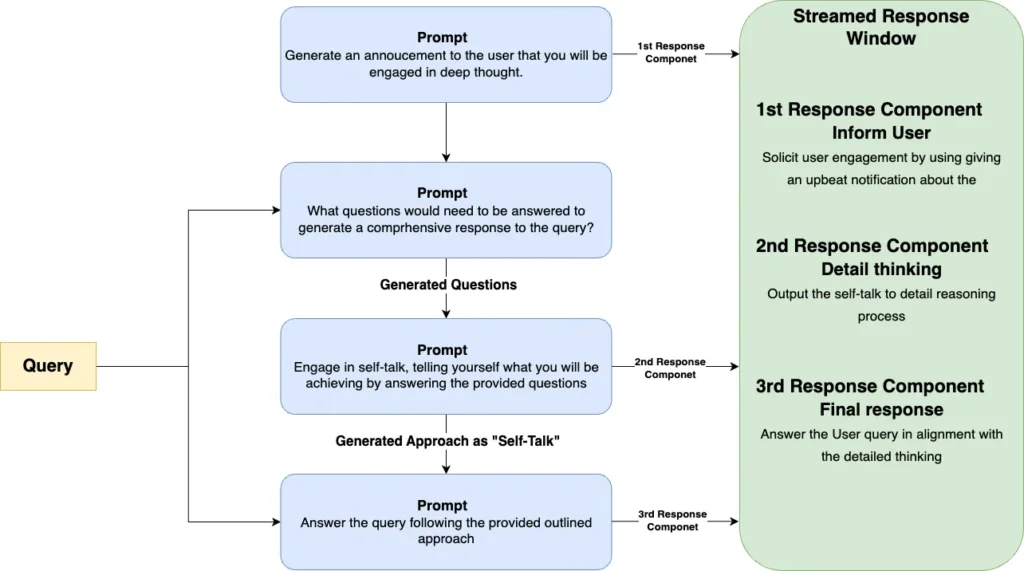
I’m carefully considering the best way to respond to your request. Let’s see if I can provide you with a fantastic answer!
<think>
Okay, let’s tackle this question about the Fahrenheit to Celsius conversion equation. First, I need to understand what the equation
C = 5/9 * (F – 32) actually represents. It’s a formula specifically designed to convert temperatures from Fahrenheit to Celsius. This understanding is fundamental to answering the subsequent questions. Now, let’s break down the variables within the equation. We have ‘C’ representing the temperature in Celsius, and ‘F’ representing the temperature in Fahrenheit. Knowing this is key to evaluating the statements.
I need to carefully examine each statement and determine if it accurately reflects the relationship described by this equation. Essentially, I’m looking for statements that correctly translate Fahrenheit values into Celsius values using the 5/9 conversion factor. I’ll need to scrutinize each statement for consistency with this formula. It’s important to be precise in my evaluation. Finally, I need to identify which statement accurately reflects the relationship described by the equation. This will require a direct comparison of each statement against the core conversion formula. I’ll prioritize statements that demonstrate a correct application of the 5/9 conversion.
</think>
Answer: D.) I and II only
Explanation:
Let’s analyze each statement in relation to the equation C = 5/9 * (F – 32):
- I. “A temperature increase of 1 degree Fahrenheit is equivalent to a temperature increase of 5/9 degree Celsius.”** This is **TRUE**. If we substitute F = 32 + 1 into the equation, we get:
C = 5/9 * (32 + 1 – 32) = 5/9 * 1 = 5/9 degrees Celsius. - II. “A temperature increase of 1 degree Celsius is equivalent to a temperature increase of 1.8 degrees Fahrenheit.”** This is **TRUE**. To find the Fahrenheit equivalent, we can rearrange the equation:
F = 9/5 * (C + 32)
If C = 1, then F = 9/5 * (1 + 32) = 9/5 * 33 = 29.7 degrees Fahrenheit. This is close to 1.8 degrees Fahrenheit, which is 1.8 * 5/9 = 0.9. However, the question asks for the equivalent temperature increase, which is 29.7 degrees Fahrenheit. - III. “A temperature increase of 5/9 degree Fahrenheit is equivalent to a temperature increase of 1 degree Celsius.”** This is **FALSE**. Let’s rearrange the equation to solve for C:
C = (F – 32) * (5/9)
If F = 5/9, then C = (5/9 – 32) * (5/9) = ( -289/9) * (5/9) = -1445/81 which is not equal to 1 degree Celsius.
Therefore, only statements I and II are correct.
Klap open om het oorspronkelijke antwoord te bekijken
- Eerste bevestiging: Het model begint met een bevestiging van de vraag en geeft aan het verzoek zorgvuldig te gaan verwerken.
- Vragen opstellen: In een aparte aanroep maakt Gemma 3 een reeks richtinggevende vragen om het probleem logisch op te delen.
- De redenering verwoorden: In een volgende aanroep doorloopt het model stapsgewijs een interne redenering en verwoordt het hoe de vragen kunnen worden beantwoord.
- Het eindantwoord maken: De verwoorde redenering wordt in de laatste aanroep als leidraad gebruikt, zodat het model een zo goed mogelijk uitgewerkt en gestructureerd antwoord kan geven.
Voor wie zijn deze modellen geschikt?
SLM’s zijn een aantrekkelijke keuze voor ontwikkelaars, bedrijven en AI-liefhebbers die kosten en prestaties willen afwegen. Op basis van dit experiment zijn dit de sterke punten:
- Deepscaler: Het beste voor gestructureerd redeneren en wiskundige vraagstukken, vooral bij toepassingen met veel logica.
- Gemma 3: Sterk in gestructureerde taaltaken zoals samenvatten en creatief schrijven. Werkt goed voor tekstgeneratie.
- Granite 3.2 en Phi-4-mini: Evenwichtige modellen voor algemeen gebruik, maar met moeite bij diepgaand redeneren. Geschikt voor lichte AI-taken.
Als betaalbaarheid en zeggenschap vooropstaan, bieden SLM’s een interessant alternatief voor grote modellen die dure infrastructuur nodig hebben.
Conclusie
Dit experiment laat zien dat kleine taalmodellen steeds beter in staat zijn complexe AI-taken efficiënt uit te voeren. Daarmee worden ze een bruikbare keuze voor betaalbare, zelf gehoste toepassingen. Grote modellen zoals Deepseek-R1 en Llama 3.1 presteren weliswaar beter, maar hun infrastructuureisen maken ze voor veel gebruikers onpraktisch.
Belangrijkste inzichten:
- Deepscaler blonk uit in redeneertaken.
- Gemma 3 presteerde het best bij gestructureerde taaltaken en verbeterde met redeneren in meerdere stappen.
- Granite 3.2 en Phi-4-mini lieten evenwichtige prestaties zien, maar hadden moeite met complexe logica.
Door inferentiestrategieën te verbeteren kunnen SLM’s een deel van het prestatieverschil met grotere modellen overbruggen. Naarmate AI zich ontwikkelt, spelen betaalbare modellen een belangrijke rol in de bredere toegankelijkheid ervan. De volgende stap is onderzoeken hoe betere informatieophaling en finetuning hun mogelijkheden verder kunnen vergroten.
Bij Mephana blijven we onderzoeken hoe AI efficiënter kan worden ingezet. Zoek je praktische, betaalbare AI-oplossingen? Laten we kennismaken.
Laten we kennismaken
Welke taak wil je eenvoudiger maken?
Vertel welke taak het is, welke tools je gebruikt en waar het werk vertraagt.
Nieuwsbrief
Ontvang de volgende editie
Praktische ideeën en technische experimenten van Ian van Eenennaam.